McKinnon: The Ice Bath
Addressing the Problem of Natural Evil and the Goodness of God
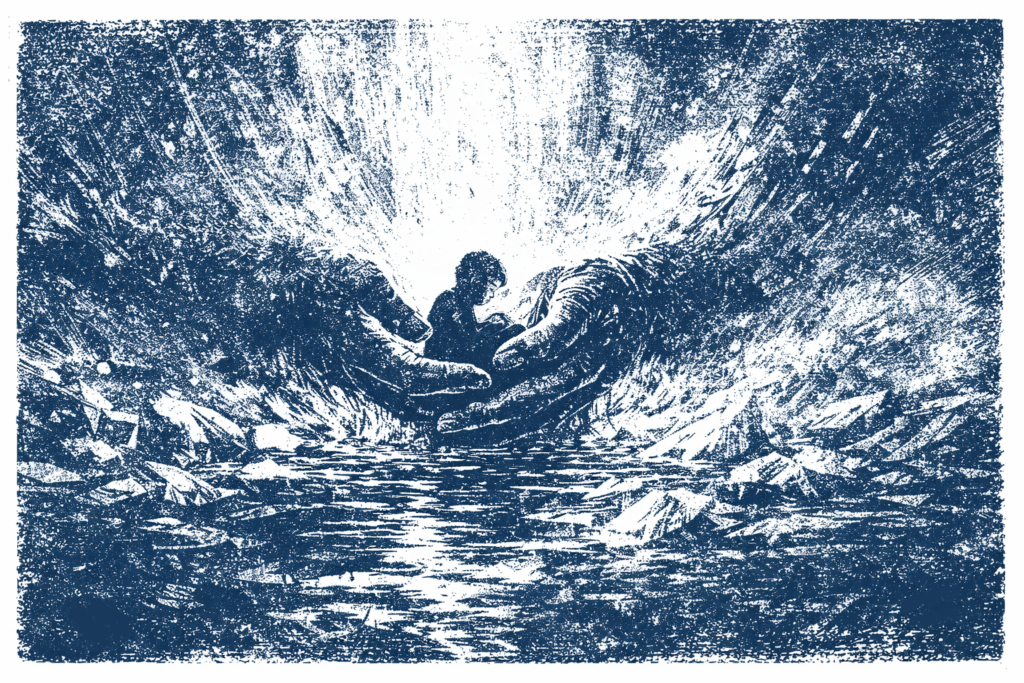
When I was barely two-years-old, I spiked a dangerously high fever; over 104 degrees. My parents were terrified. They called the pediatrician, ready to rush me to the ER. But the doctor said something they didn’t expect: “Fill the bathtub with cold water and dump every ice cube you have into it. You need to get his temperature down immediately.”
So my parents did exactly that. And then, because I was too small and too weak to cooperate, they held me down in that freezing water as I screamed and cried.
To me, it was pure terror, suffering without explanation. There was nothing anyone could have said in that moment that would convince the two-year-old me that this was good, or necessary, or certainly loving. I simply didn’t have the capacity to understand.
But my parents did.
As I grew older, something about that story changed for me. In that moment, even though I wasn’t the one who understood what was happening, my parents did. They weren’t being cruel. They weren’t indifferent. They weren’t powerless. They were acting with a kind of knowledge and love that my two-year-old mind simply could not grasp. And tucked inside this context, Scripture’s claim that we are made “in the image and likeness of God” suddenly didn’t feel so abstract. It felt like an analogy staring me in the face.
Now, I am a father myself. And as a father, there are moments when I must let my children face things I wish I could spare them, yet I know those very things will ultimately protect them, shape them, or save them, even when they cannot see that for themselves.
Here’s the interesting thing: adults move through the world as though we essentially comprehend everything important about reality. Most of the time this underlying belief operates unconsciously, almost like a background program that helps facilitate our daily existence. And it is precisely from this unexamined perspective that the hardest questions of suffering, natural disasters, and uncaused disease present themselves as the “problem of natural evil.” When examined from within this perspective, it can be tempting to conclude that such evils constitute decisive evidence that there simply cannot be a God, or, at the very least, not an all-Good and Loving God.
But what happens when we shift our perspective?
Think back to that ice bath and that two-year-old child who lacked the cognitive or emotional architecture to understand what the parent understood. That lack of understanding is not caused because the parent is bad or hiding something. It exists because the gap in the ability to understand is simply too great. If the distance between my two-year-old mind and my parents’ minds was enough to make goodness appear as cruelty, then what happens across the infinitely greater distance between human understanding and the mind of God?
Catholic thinkers from Augustine to Aquinas have taught precisely this principle: there are goods God understands that we, in our present state, simply cannot. Not because God is playing games with us or “hiding the ball,” but because His perspective is categorically beyond ours. Just as I could not now explain the ice bath to my two-year-old self in any compelling way, it is logically congruent that God may not be able to explain the deepest reasons behind natural suffering in terms we could presently comprehend.
This is where many skeptics begin to roll their eyes, assuming this to be a “cop-out.” But it is not. A genuine cop-out interrupts logical reasoning by injecting an unfalsifiable postulation as an explanation. This is different. This is an epistemic fact and a reasoned conclusion that logically flows uninterrupted from an airtight analogy, one that many of us have literally experienced as true.
In my childhood example, my inability to understand did not make my parent’s act unjust. Thus, it seamlessly follows that our inability to understand a perceived evil now does not warrant the conclusion that God’s governance is evil.
More directly, the reasoning holds because the logical structure of the two scenarios is identical:
- A loving agent with greater knowledge.
- A vulnerable being incapable of grasping the reason.
- A painful experience ordered toward a greater good.
- Apparent cruelty that is, in truth, an act of protection or healing.
In the case of the ice bath, my childish interpretation produced a mistaken conclusion of malevolence. Later, I recognized that the conclusion had been drawn from a drastically limited perspective. And importantly, the fact that the conclusion was false does not mean it was irrational for a two-year-old to draw it. It was, in fact, the best conclusion available to the limited cognitive resources of that moment.
Tethering this insight to my Catholic faith, and looking “up the intelligence scale,” reveals something profoundly reasonable: just because I cannot see any good reason for certain sufferings now does not justify the conclusion that no good reason exists. If we simply posit the God we say we believe in into the equation, the scenario falls into place without altering anything essential about Him. The toddler in the ice bath could not see the good, but the good existed. Likewise, you and I, standing inside time with limited intelligence, limited knowledge, and limited vantage point, may see suffering that feels impossible to justify, but this does not warrant conclusion that no justification exists.
The God we believe in is infinitely wiser, infinitely more loving, infinitely more knowledgeable. Thus, it is perfectly reasonable to conclude that the mere fact we cannot discern the purpose of certain evils tells us nothing about whether a purpose exists, or even whether the event is contextually evil at all. Our horizon is small. His is infinite.
If we go one layer deeper, Christianity adds something unique and astonishing. The Christian God does not merely allow suffering for reasons we do not yet understand. He enters into it. He takes on the greatest pain, grief, betrayal, and injustice; not from a distance, but personally, bodily. The God who permits suffering is the God who suffers with us. The God who allows death is the God who conquers it.
And while this analysis does not claim to provide every ultimate answer to the mystery of natural evil, it hopefully sheds light on the kind of heart that lies behind that mystery. If a parent’s love can transform a painfully cold ice bath from cruelty to care, how much more can the love of God transform what we do not yet understand?
In summary: I did not understand that ice bath when I was two. But the truth was there all along; a greater good working quietly through temporary suffering. For Catholics, a properly ordered view of the problem of natural evil rests precisely there: not in an unthinking surrender to God’s goodness, but in a reasoned trust grounded in an experience we all share.
For if we are truly made in the image and likeness of God, then our suffering is not evidence of abandonment, but evidence that we, like children, are being carried through something we do not yet have the capacity to understand.
But one day, with a fuller mind and a resurrected perspective… we will.
God Bless and Happy New Year!